The US vaping landscape has become a patchwork of state-level regulations, with rules varying significantly from one state to the next. As of 2026, no federal law bans all flavored vapes, but at least 12 states have enacted significant restrictions, ranging from complete flavor bans to state-approved product directory systems.
This guide breaks down which states have banned flavored vapes, which regulatory models they use, and where flavored products remain fully legal.
How the Flavored Vape Ban Movement Works in the US
Not all flavored vape bans work the same way. States have taken three distinct approaches to restricting vaping products, and understanding the difference matters before diving into the specifics.
The three regulatory models currently in use are:
Complete flavor bans that cover nearly all flavored products, including menthol
Partial bans that restrict most flavors while exempting menthol and tobacco
State product directory systems that limit sales to a state-approved list of products rather than banning specific flavors outright
Local restrictions can apply independently of state law. In several states, city and county governments have enacted their own flavor restrictions, meaning a jurisdiction may have additional rules even where no statewide ban exists.
States With a Complete Flavored Vape Ban
Some states have gone further than any other state, enacting comprehensive bans that cover fruit, candy, mint, dessert, and in most cases menthol flavors. In these states, the legal market for flavored vaping products has been largely eliminated at the retail level.
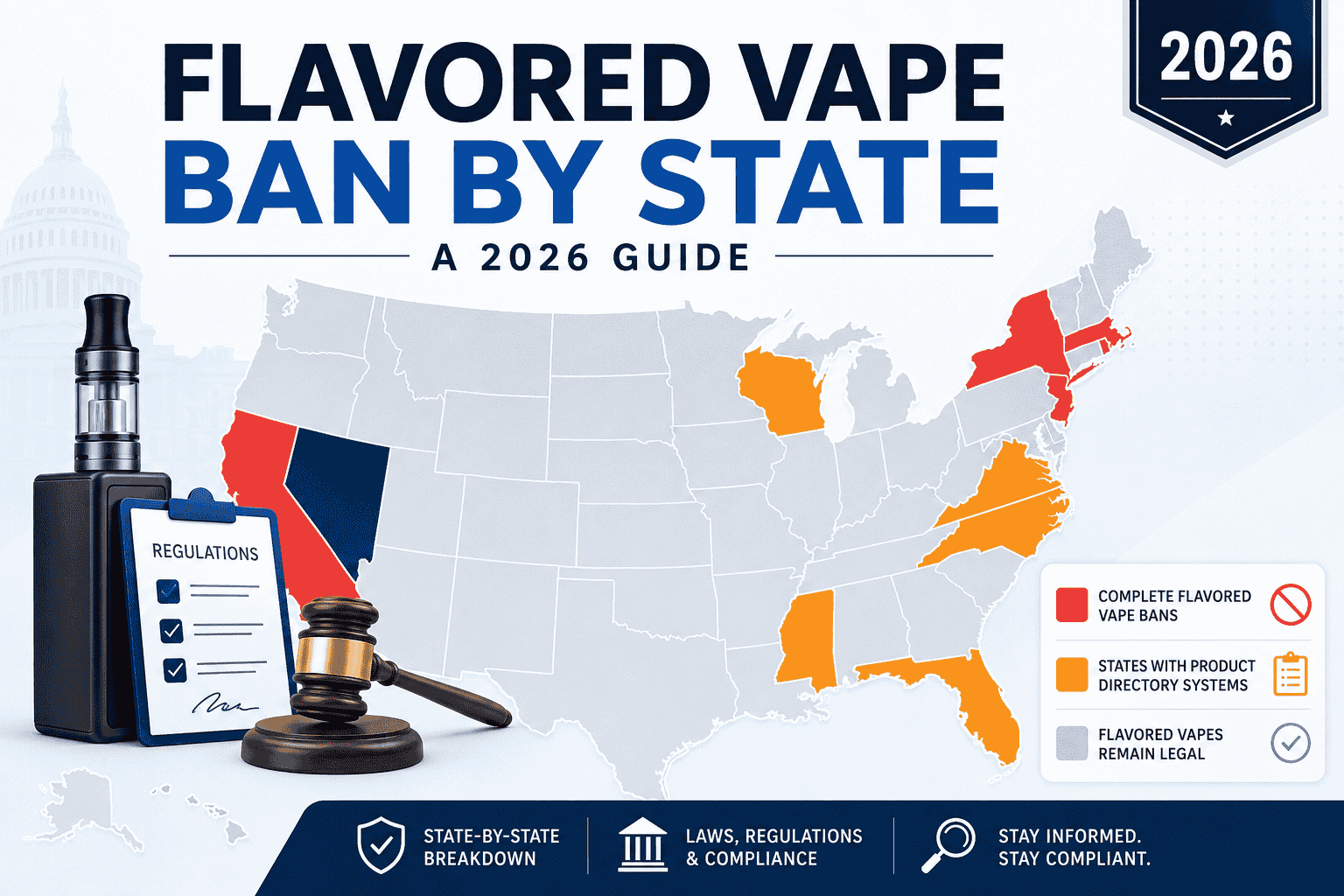
The states with the most sweeping restrictions as of 2026 are California, Massachusetts, New Jersey, New York, and Rhode Island. Washington DC follows a comparable model.
Here’s what each state’s ban actually covers:
California Flavored Vape Ban
California has one of the strictest flavored vape bans in the country, and it got tighter at the start of 2026. UnderProposition 31, upheld by voters in November 2022, and strengthened byAssembly Bill 3218, the California flavored vape ban now covers virtually every non-tobacco flavor available.
As of January 1, 2026, an additional “Unflavored Tobacco List” (UTL) requirement took effect, meaning only products that appear on the California Attorney General’s approved list can legally be sold in the state. Fruit, candy, mint, menthol, dessert, and even products with a “cooling sensation” that mimics menthol are all prohibited. Online sales shipping to California addresses fall under the ban as well. Retailers and distributors that violate these rules face penalties of up to $4,000 per violation.
If you’ve noticed your go-to flavored vape disappearing from California shelves, that’s the regulatory environment at work, not a supply issue.
Massachusetts
Massachusetts was one of the earliest adopters of a statewide flavored vape ban, passingAn Act Modernizing Tobacco Control in 2019 that covered all flavored tobacco and vaping products, including menthol.
The ban remains fully in effect as of 2026, with no meaningful changes to its scope. Massachusetts set the early template that several other states would eventually follow.
New York and New Jersey
Both New York and New Jersey prohibit flavored vaping products under their respective public health statutes.
New York’s ban, codified underN.Y. Public Health Law § 1399-mm-1(2), covers all flavored vapor products, including menthol. New Jersey follows a similarly comprehensive framework under S3265, signed into law in January 2020. Both bans apply to retail sales within each state.
Rhode Island
Rhode Island joined the group with a ban effective January 1, 2025, prohibiting most flavored vaping products.
Rhode Island’s approach to menthol and tobacco flavors differs slightly from California’s and Massachusetts’ all-in model, making it a near-complete rather than fully comprehensive ban in practice. Still, the impact on product availability in the state has been substantial.
States Using Product Directory Systems
Not every state with significant vaping restrictions has gone the route of outright flavor bans. Several states have instead built product directory systems, which are state-maintained approved lists that determine which products can legally be sold.
The practical effect is similar to a ban in some ways: any product not on the list simply can’t be sold, and most flavored disposables and unauthorized products don’t make the cut. States currently using this model as of 2026 include Virginia, Florida, North Carolina, Wisconsin, and Mississippi.
Florida’s approach targets disposable vapes specifically through its Nicotine Dispensing Device (NDD) Directory, while generally leaving refillable e-liquid products less affected. If you use a refillable device and your products meet federal standards, your options in Florida are broader. If you rely on flavored disposables, availability is heavily restricted.
Wisconsin and North Carolina’s directories function similarly, effectively removing most unauthorized or non-PMTA-compliant products from the market without technically banning flavors as a category.
States with Targeted Disposable Vape Restrictions
A newer wave of legislation has zeroed in on disposable vaping devices as a distinct category, rather than targeting flavors or vaping products broadly.
Texas is the primary example of this approach. The state enacted restrictions specifically targeting Chinese-manufactured disposable vapes, focusing on unauthorized imports rather than flavors in general. The legislation reflects a growing legislative trend that separates the disposable vape question from the flavor ban question.
Other states are watching Texas’s model closely. Several are considering similar disposable-specific legislation in 2026, suggesting this targeted approach may spread even as the flavor-ban debate continues on a separate track.
When Does the Flavored Vape Ban Start? Key Dates by State
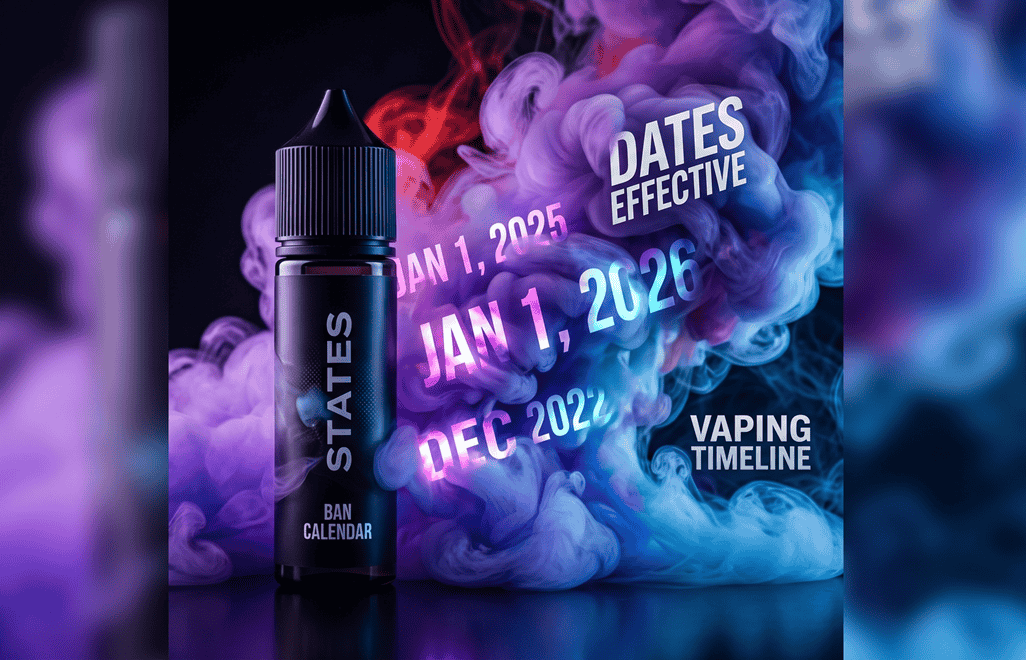
If you’ve heard about an upcoming ban and want to know when does the flavored vape ban start, here’s a timeline of the key effective dates:
California: Proposition 31 was upheld by voters in November 2022, making the broad flavor ban effective in December 2022. AB 3218 and the Unflavored Tobacco List requirement added additional restrictions effective January 1, 2026.
Rhode Island: Flavor ban effective January 1, 2025.
Utah: Flavor restrictions effective January 1, 2025, though implementation faced a temporary restraining order due to pending litigation as of early 2025. Check the Utah Department of Health for current enforcement status.
Virginia: Directory expansions affecting which products can be sold went into effect in 2026, with ongoing updates to the approved product list.
The regulatory calendar keeps moving. New legislation is being considered in several states, including Illinois, Ohio, and Pennsylvania. Before assuming what’s legal in your area, always verify directly with your state’s health department or tobacco control office, as these dates can shift as legal challenges work through the courts.
States Where Flavored Vapes Are Still Legal in 2026
Despite the momentum toward restrictions, approximately 20 states have minimal vaping-specific regulation beyond federal baseline law, meaning flavored vapes remain legally available for adult consumers.
That said, “no statewide ban” doesn’t mean no rules. Federal law still applies everywhere: the minimum purchase age is 21 nationwide (Tobacco 21), the FDA’s Pre-Market Tobacco Application (PMTA) process governs which products can be legally marketed, and state excise taxes still affect pricing in most states.
Local ordinances add another layer. Even in states without statewide flavor bans, major cities have moved independently. Chicago, Denver, Columbus, and Minneapolis have all enacted municipal-level restrictions. Always check both your state law and any local ordinances before assuming full availability where you live.
Is Nevada One of the States With a Flavored Vape Ban?
Nevada does not have a statewide flavored vape ban as of 2026.
The state regulates vaping primarily through theNevada Clean Indoor Air Act (which restricts indoor use in most public spaces and workplaces), a 21+ minimum purchase age requirement, and a 30% wholesale excise tax on vapor products. A proposed statewide flavor ban,Senate Bill 435, was introduced during Nevada’s 2025 legislative session but failed on June 3, 2025, when the legislature adjourned without the Assembly taking action on the measure.
What that means for adult consumers is that flavored vaping products, including fruit, dessert, menthol, and nicotine salts, remain legally available for purchase in Nevada.
Adult consumers looking for a wide selection of legal flavored e-liquids in Nevada can visit Pink Spot Vapors, a Las Vegas vape shop carrying an extensive range of flavors in-store and via online delivery. Whether you are exploring nicotine salts or browsing the best vape juice flavors, Pink Spot Vapors stocks a broad selection of legally available products for adults 21 and over.
As always, adult shoppers outside Nevada should verify whether Nevada vape laws permit online orders of flavored products to their address before placing an order.
What the Federal Government Says About Flavored Vapes
Federal regulation of vaping runs through the FDA’s Pre-Market Tobacco Application (PMTA) process, which requires manufacturers to demonstrate that their products meet public health standards before they can be legally marketed in the United States.
As of 2026, there is no federal law that bans all flavored vapes. However, the FDA has issued marketing denial orders and warning letters that have effectively removed more than 1,200 unauthorized products from the market.
The majority of those are flavored disposables from overseas manufacturers that never filed PMTA applications. The FDA has also issued new draft guidance in 2026 that could create pathways for certain non-fruit, non-candy flavor categories (such as mint, coffee, and tea) to pursue authorization, though no such products have been approved yet.
The one universal federal rule that applies in all 50 states, regardless of other regulations, is Tobacco 21. This is the federal minimum age law requiring buyers to be 21 years or older to purchase any tobacco or vaping product.
Understanding this federal layer is important because state bans often build on top of FDA enforcement rather than replacing it. Both sets of rules apply simultaneously.
What to Do If You Live in a Flavored Vape Ban State
Living in a banned state requires a more careful approach, and the most important thing is to understand what’s actually legal where you are before you purchase anything.
Here is practical guidance for adult consumers navigating a restricted state:
Know your state and local laws. Check your state health department’s website and any local ordinances before purchasing. Ban states apply their restrictions to online orders shipped to in-state addresses, so buying online from an out-of-state retailer does not bypass the rules.
Explore what is still available locally. In most partial-ban states, tobacco-flavored products remain legally available. Some states exempt menthol as well. If you are in a partial-restriction state, checking what is on the approved list is worth doing.
Consider legal options outside your state. Nevada law permits the sale of flavored e-liquids to adult consumers, including nicotine salts and a wide range of flavor profiles. Pink Spot Vapors, based in Las Vegas, offers both in-store shopping and online delivery for adults 21 and over in states where such orders are permitted. Verify the shipping legality for your own state before placing an order.
Frequently Asked Questions
What states have a flavored vape ban in 2026?
As of 2026, the states with the most comprehensive flavored vape bans are California, Massachusetts, New Jersey, New York, and Rhode Island. Washington DC follows a comparable model. Colorado, Oregon, and Washington have also enacted flavor restrictions. Additional states use product directory systems (Florida, Wisconsin, North Carolina, Virginia, Mississippi) that restrict availability without technically banning flavors outright.
Is there a federal flavored vape ban?
No. As of 2026, there is no federal law banning all flavored vapes. The FDA regulates vaping products through the PMTA authorization process and has removed more than 1,200 unauthorized products from the market, but federal law does not prohibit flavored vaping products categorically. Individual state laws vary widely.
When does the flavored vape ban start in my state?
It depends on your state. California’s current enforcement framework includes restrictions effective December 2022 (Prop 31) and January 1, 2026 (AB 3218 / UTL). Rhode Island and Utah bans took effect January 1, 2025. Virginia’s directory system has been updated in 2026. Always check your state’s official health department or tobacco control office for the current effective date and enforcement status.
Does the California flavored vape ban cover online orders?
Yes. The California flavored vape ban extends to online sales. Retailers shipping flavored products to California addresses are subject to the same restrictions as in-state retailers. Purchasing online from another state does not exempt California buyers from the ban.
Are flavored vapes still legal in Nevada?
Yes. Nevada does not have a statewide flavored vape ban as of 2026. SB 435, which would have created a flavor ban, was defeated in the 2025 legislative session. Flavored e-liquids, nicotine salts, menthol, and other flavored products remain legally available to adults 21 and over. Nevada’s primary vaping regulations cover minimum age (21+), indoor use restrictions, and a 30% wholesale excise tax.
Does the flavored vape ban include menthol?
It depends on the state. California, Massachusetts, and New York’s bans include menthol. Rhode Island and New Jersey treat menthol differently, and partial-ban states may exempt it entirely. Always check your specific state’s law, as “flavored vape ban” doesn’t automatically mean menthol is included.
What is a state vape product directory and how does it work?
A state product directory is a list maintained by the state government of vaping products approved for sale within that state. Retailers can only legally sell products that appear on the list. Products not on the list, including most flavored disposables and products without PMTA authorization, cannot be sold regardless of whether there is an explicit “flavor ban” in that state. States using this model include Florida, Wisconsin, North Carolina, Virginia, and Mississippi.
Subscribe now to keep reading and get access to the full archive.
"*" indicates required fields
Table of Contents
About the Author
Shelby Bockman
Shelby is a vape industry professional with more than seven years of experience in the vaping community and currently serves as a manager at Pink Spot Vapors, a well-known Las Vegas vape shop. With extensive knowledge of vaping devices, premium e-liquid, nicotine strengths, and flavor profiles, Shelby helps customers find the perfect vape setup to match their preferences and lifestyle.
Her expertise includes guiding both beginners and experienced vapers through the wide range of vape devices, helping them understand nicotine levels, and introducing them to unique e-liquid flavor profiles. Shelby is passionate about helping customers discover high-quality vape products while promoting responsible vaping and a personalized customer experience.
At Pink Spot Vapors in Las Vegas, Shelby also creates content that highlights the craftsmanship behind premium e-liquid, innovative flavor blends, and the creativity within the vape community. Her hands-on experience and passion for vaping help customers explore new flavors, find the right devices, and enjoy a better vape experience.
About the Author
Shelby Bockman
Shelby is a vape industry professional with more than seven years of experience in the vaping community and currently serves as a manager at Pink Spot Vapors, a well-known Las Vegas vape shop. With extensive knowledge of vaping devices, premium e-liquid, nicotine strengths, and flavor profiles, Shelby helps customers find the perfect vape setup to match their preferences and lifestyle.
Her expertise includes guiding both beginners and experienced vapers through the wide range of vape devices, helping them understand nicotine levels, and introducing them to unique e-liquid flavor profiles. Shelby is passionate about helping customers discover high-quality vape products while promoting responsible vaping and a personalized customer experience.
At Pink Spot Vapors in Las Vegas, Shelby also creates content that highlights the craftsmanship behind premium e-liquid, innovative flavor blends, and the creativity within the vape community. Her hands-on experience and passion for vaping help customers explore new flavors, find the right devices, and enjoy a better vape experience.